Inquiry:

flora@nvchemical.com
+86-17191109819
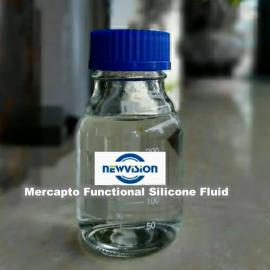
Product name:Mercapto-Functional Silicone Fluid
Product code: NV-SiMT2060
Alias:Thiol-functional silicone fluid
Chemical Information
Main Components:Mercaptopropyl methylsiloxane-dimethylsiloxane copolymer;Methylmercaptopropyl Silicone Fluid
Cas no.:101810-99-5 or 102783-03-9Molecular structure:

Characteristics:
Highly reactive thiol groups: the pendant mercaptopropyl (-CH2CH2CH2SH) groups readily undergo efficient thiol-ene "click" reactions with unsaturated bonds (e.g., acrylate, vinyl) under UV light or electron beam (EB) irradiation.
Intrinsic Silicone Properties:possesses the inherent characteristics of polysiloxanes, including excellent thermal stability, low surface energy, and high flexibility.
Stable molecular backbone:the dimethylsiloxane structure provides good oxidative stability and chemical inertness under a wide range of conditions.
Key Benefits :
Permanent, Non-Migrating Modification: Unlike traditional silicone fluids, NV-SiF2060 chemically bonds into the host matrix, ensuring permanent lubrication, release properties, and surface effects without oil migration or bleeding.
Boosted Rad-Curing Efficiency: Significantly accelerates UV/EB curing speed by mitigating oxygen inhibition, while simultaneously reducing polymerization shrinkage stress and improving substrate adhesion.
Enhanced Surface Mechanics: Delivers consistent, long-lasting slip, anti-blocking, and scratch resistance to cured coatings and polymer films.
Versatile Formulation Value: Functions seamlessly as a reactive modifier, structural chain transfer agent, or performance enhancer across diverse chemical systems.
Typical Properties:
Appearances colorless transparent to translucent liquid
Viscosity(25℃)
Refractive index
Item
NV-SiMT2060-10
NV-SiMT2060-20
5cst
10cst
1.4128
1.4082
Non-volatile content (105℃,2h)
90%
90%
Applications
1. Applications based on "thiol-ene" photoclick chemistry core applications)
This reaction is fundamental to its use in UV/EB curing systems for building crosslinked networks or acting as a reactive diluent.
* UV/EB Curable Coatings and Inks:
Used as a reactive functional monomer in optical fiber coatings, protective coatings for electronics, 3D printing resins, etc. It significantly reduces curing shrinkage stress, enhances coating flexibility and adhesion, and improves surface lubricity.
* Optical Adhesives and Pressure-Sensitive Adhesives PSAs):
Formulated with vinyl silicones or acrylate resins to produce high-performance adhesives with specific refractive indices, tack, and aging resistance via photocuring.
* Polymer Network Modifier:
Incorporated as a co-monomer into networks of other vinyl polymers e.g., acrylic resins), permanently imparting silicone-like hydrophobicity and flexibility.
2. Applications as a high-performance release & anti-stick agent
* Internal release agent for rubbers & plastics:
Provides lasting mold release in peroxide or sulfur-cured rubber e.g., silicone, EPDM) and plastic processing.
* Component for release coatings: used in formulating durable release papers and films.
* Anti-stick for office equipment: prevents toner adhesion on fuser rollers in copiers/printers.
3.Other Functional Additive Applications
* Polymer processing aid: acts as an anti-blocking agent for powders/pellets and a chain transfer agent in radical polymerizations.
* Textile finishing: imparts durable shrink resistance to wool through chemical reaction with keratin.
* Metal protection: functions as a corrosion inhibitor additive in coatings or oils and enhances coating adhesion.
* Stability enhancer: improves the thermal-oxidative stability of dimethyl silicone fluids when blended.
Application Guide
Formulation Integration:
UV/EB Curing: When used as a reactive additive, the recommended dosage is typically 1-5% by weight of the total formulation to improve surface slip and oxygen inhibition. For cross-linking main resins (thiol-ene system), calculate the dosage based on the molar ratio of Thiol : Vinyl (ideally 1:1 equivalent ratio).
Catalyst Selection: For non-UV applications (e.g., addition to epoxies or isocyanates), basic catalysts like tertiary amines or organic tin/zinc compounds can accelerate the reaction.
Compatibility: NV-SiF2060 has good compatibility with most dimethyl silicone fluids and many acrylate monomers. However, it is highly recommended to perform a compatibility test before bulk mixing.
Thinning: If dilution is required, use non-polar organic solvents such as aliphatic hydrocarbons, aromatics, or low-viscosity silicone fluids (e.g., 0.65cSt-2cSt PDMS).
Handling & Precautions
Odor Management: Mercapto-functional silicones have a characteristic sulfur odor. Operations should be conducted in a well-ventilated area or under a local exhaust hood.
Oxidation Prevention: Thiol groups (-SH) can be slowly oxidized to disulfides (-S-S-) when exposed to air.
Keep containers tightly sealed when not in use.
Nitrogen blanketing (purging) is highly recommended after opening to extend shelf life.
Avoid Contamination: Keep away from strong oxidizers, strong acids, bases, and heavy metal catalysts (unless intended for reaction) to prevent premature gelation or degradation.
Personal Protection:
Wear protective gloves (nitrile recommended), safety goggles, and protective clothing.
In case of skin contact, wash thoroughly with soap and water. In case of eye contact, flush with plenty of water for at least 15 minutes and seek medical attention.
Spill Cleanup: Absorb spills with inert materials (sand, earth, or vermiculite) and dispose of according to local environmental regulations.
Storage:
Stored in a sealed and dark place.After the container is opened, it is recommended to use it up as soon as possible.
Storage period : 6 months under normal temperature 3-30℃.
Low temperatures can cause changes in the appearance and fluidity of products, it is important to antifreeze and keep warm during winter.
Contact: Flora
Phone: +86-17191109819
Tel: +86-17191109819
Email: flora@nvchemical.com
Whatsapp: +86-17191109819
Add: 36# YONGSHUI QIAO ROAD,NINGBO,ZHEJIANG,CHINA
 Flora
Flora +86-17191109819