Inquiry:

flora@nvchemical.com
+86-17191109819
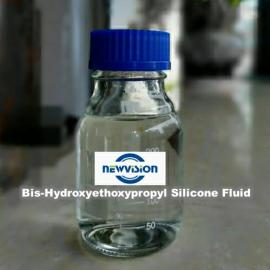
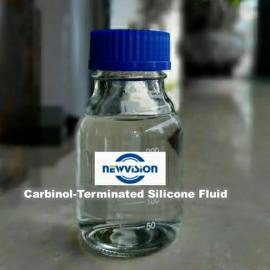
Product name:Bis-Hydroxyethoxypropyl silicone fluid
Product code:NV-SICB2050-*
Chemical Information:
Main components: Siloxanes and Silicones, di-Me, 3-(2-hydroxyethoxy)propyl group-terminated
Cas no.: 222416-17-3 or 156327-07-0
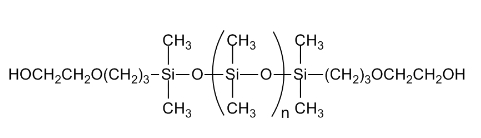
Molecular structure:HO-CH2CH2-O-(CH2)3-PDMS-(CH2)3-O-CH2CH2-OH
Product Description
Unlike traditional hydrolyzable Si-O-C bound carbinol silicones, it features robust Si-C (silicon-carbon) bonds linking the hydroxyethoxypropyl functional groups to the siloxane backbone. This unique structural design not only provides high hydrolytic stability—resisting cleavage by water, acids, or bases to ensure the modified network retains its performance over time—but also leverages the terminal −CH2OH groups for high reactivity. These primary alcohol groups react more readily with isocyanates (−NCO ), carboxylic acids (−COOH ), acid anhydrides, and epoxies compared to secondary or phenolic hydroxyls. By marrying the inherent performance of siloxanes with the reactive versatility of primary alcohols, NV-SICB2050 series serves as a high-performance reactive intermediate or permanent modifier for polyurethane, epoxy, and polyester systems.
Typical propertes:
|
Model |
Viscosity (25℃,cSt) |
Hydroxyl content (KOH mg/g) |
Molecular weight |
Refractive index (25℃) |
|
SICB2050--20 |
10-40 |
214-222 |
500 |
1.4192 |
|
SICB2050-30 |
15-35 |
100-112 |
1000 |
1.4175 |
|
SICB2050-40 |
30-60 |
52-60 |
2000 |
1.4164 |
|
SICB2050-60 |
40-60 |
37-47 |
3000 |
1.4117 |
|
SICB2050-80 |
100-200 |
28-35 |
4000 |
1.4082 |
Key Benefits & Features
Permanent Co-Monomer Modification: Chemically integrates directly into polymer chains (e.g., Polyurethanes), preventing additive migration, leaching, or surface bleeding.
Enhanced Surface Mechanics: Imparts exceptional, long-lasting surface slip, mar/scratch resistance, and anti-blocking attributes to cured films.
Hydrophobicity & Release Properties: Lowers surface energy to deliver reliable water repellency, stain resistance, and easy-clean/mold-release properties.
Flexibility & Impact Modification: The flexible dimethicone backbone provides internal plasticization, improving low-temperature flexibility, impact strength, and stress relaxation.
Applications
Polyurethane (PU) Modification: Widely used as a soft-segment co-monomer in PU synthetic leather, waterborne polyurethane dispersions (PUDs), elastomers, and coatings to improve hand-feel, slip, and water resistance.
Epoxy & Polyester Resin Modifier: Reacts into epoxy resins or saturated/unsaturated polyesters to reduce brittle failures, relieve internal thermal stress, and enhance surface anti-smudge properties.
Personal Care & Cosmetics: Functions as a premium sensory modifier in skin care and color cosmetics, providing a silky, non-greasy feel and pigment-wetting capabilities.
Textile & Leather Finishing: Used as a reactive chemical finishing agent to yield durable softness and smooth touch that survives repeated laundering.
Application Guide
Grade Selection Strategy:
Choose lower molecular weight grades (e.g., -20, -30) if you require higher cross-linking density,higher hydroxyl density, or a higher refractive index.
Choose higher molecular weight grades (e.g., -60, -80) if your focus is maximizing silicone surface properties (slip, release, hydrophobicity) and internal flexibility.
Formulation & Stoichiometry: For copolymerization (e.g., in polyurethane synthesis), calculate the required mass based on the Hydroxyl Value (50 mg KOH/g) to achieve the target isocyanate index (NCO/OH equivalent balance).
Dosage: When utilized as an additive/surface modifier, a dosage of 0.5%–5%wt of the total formulation is typically sufficient to dramatically optimize slip and release performance.
Dilution: If pre-dilution is preferred, NV-SICB2050 is fully compatible with common industrial solvents including butyl acetate, MEK, toluene, and low-viscosity cyclic or linear silicone fluids.
Handling & Precautions
General Handling: Ensure adequate workplace ventilation. Avoid direct inhalation of vapors or mists.
Personal Protection: Wear appropriate chemical-resistant gloves (e.g., nitrile rubber), protective clothing, and safety goggles during handling.
Hygiene Measures: In case of skin contact, wash thoroughly with soap and water. If exposed to eyes, rinse immediately with plenty of running water for at least 15 minutes and seek medical advice.
Spill Cleanup: Clean up spills immediately using absorbent materials (sand, diatomaceous earth, or commercial sorbents) and dispose of in compliance with local environmental statutes.
Package:
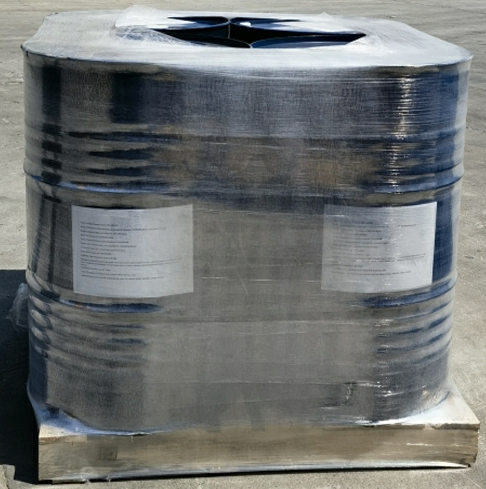
25KGS, 190kg-200kg/drum
Storage:
Store in original, tightly sealed containers in a cool, dry, and well-ventilated warehouse.
Moisture Protection: Because terminal primary hydroxyl groups can slowly absorb moisture from the air, containers should be tightly resealed after opening. Nitrogen purging prior to resealing is recommended to safeguard quality.
Shelf Life: 12 months from the date of manufacture when stored in unopened, original containers under the recommended temperature range 5–35℃. Keep away from direct sunlight, open flames, and strong oxidizing agents.
Contact: Flora
Phone: +86-17191109819
Tel: +86-17191109819
Email: flora@nvchemical.com
Whatsapp: +86-17191109819
Add: 36# YONGSHUI QIAO ROAD,NINGBO,ZHEJIANG,CHINA
 Flora
Flora +86-17191109819