Inquiry:

flora@nvchemical.com
+86-17191109819
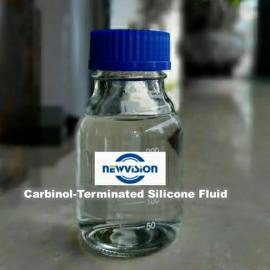
Product name:Carbinol-Terminated Silicone Fluid;
Product code:NV-SICB2070-*
Alias:Bis-HydroxyAlkyl Terminated Silicone Fluid
Chemical Information
Main components: Bis-hydroxyalkyl dimethicone
Cas No.: 156327-07-0
Molecular structure:HOCH2−(CH2)m−Si(CH3)2−(OSi(CH3)2)n−Si(CH3)2−(CH2)m−CH2OH
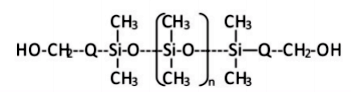
Q=(CH2)m ((Alkyl spacer group)
Product Description
The NV-SiCB2070 series consists of 100% active, linear, bis-hydroxyalkyl terminated polydimethylsiloxane fluids available in various molecular weight grades. By incorporating primary carbinol hydroxyl groups (CH2OH) specifically at both chain ends via stable silicon-carbon (Si-C) linkages, these specialty fluids combine the typical benefits of reactive siloxanes—such as slip, water repellency, and low-temperature flexibility—with the precise reaction kinetics of primary alcohols. They serve as exceptional reactive building blocks, soft segments, or permanent modifiers for polyurethanes, epoxies, and coatings.
Chemical Character & Reactivity
Non-Hydrolyzable Backbone: Unlike traditional Si-O-C bound silicone alcohols that are prone to moisture cleavage, the NV-SiCB2070 series relies on direct Si-C (silicon-carbon) bonds to secure the reactive groups. This ensures outstanding hydrolytic, thermal, and chemical stability in the final cured product.
Highly Reactive Primary Hydroxyls: The terminal CH2OH groups are highly accessible and provide significantly faster reaction rates compared to secondary or hindered alcohol structures when reacted with:
Isocyanates (NCO) for Polyurethanes (PU/WPU)
Carboxylic acids (COOH) or anhydrides for Polyesters
Epoxies and Alkoxysilanes
Typical propertes:
| Product Code |
Molecular Weight |
|
NV-SiCB2070-40 |
2000 |
|
NV-SiCB2070-60 |
3000 |
|
NV-SiCB2070-80 |
4000 |
Key Benefits & Features
Zero Migration & Bleeding: Because the fluid acts as a macro-diol and copolymerizes directly into the polymer matrix backbone, the silicone properties are permanent and will not leach, fog, or degrade surface adhesion over time.
Premium Surface Slip & Mar Resistance: Provides a consistent, luxurious, smooth hand-feel and significantly enhances scratch, mar, and abrasion resistance.
Hydrophobic & Anti-Smudge Protection: Drastically lowers surface energy, imparting excellent water/oil repellency, anti-blocking behavior, and easy-clean (anti-marker/anti-graffiti) traits.
Internal Plasticization: The highly flexible dimethylsiloxane segments act as an internal soft segment, enhancing impact strength, stress relief, and low-temperature elasticity in brittle thermoset systems (like epoxies).
Applications
Synthetic Leather & Waterborne Polyurethanes (PUDs): Incorporated as a reactive soft segment to eliminate the sticky feel of PU coatings, offering a silky touch, excellent flexing endurance, and weatherability.
Epoxy Resin Toughening: Reacts into epoxy coatings, composites, and structural adhesives to lower modulus, prevent micro-cracking under thermal shock, and deliver built-in mold-release properties.
Coating & Paint Formulation: Utilized as a reactive resin modifier in automotive OEM coatings, coil coatings, and marine protective paints to upgrade weatherability, UV resistance, and surface slip.
Textile & Industrial Leather Treatment: Imparts a highly durable, washable soft finish to materials via covalent chemical attachment.
Application Guide
Grade Selection:
NV-SiCB2070-40 provides a higher hydroxyl concentration, making it excellent for tighter cross-linking densities and formulations needing minimal impact on base polymer hardness.
NV-SiCB2070-60 & -80 feature longer siloxane chain segments, maximizing surface slip, release efficiency, and matrix flexibility.
Stoichiometry Calculation: For synthesis (e.g., polyurethane pre-polymer design), calculate the exact required weight according to the specific Hydroxyl Content (mg KOH/g) of the selected grade to balance the target NCO/OH stoichiometric ratio.
Compatibility & Blending: NV-SiCB2070 shows good compatibility with many polyols, polar organic solvents (such as esters, ketones, and aromatics), and can be easily pre-thinned or dispersed before reaction.
Handling & Precautions
Ensure adequate ventilation at the workplace. Avoid inhalation of mist or vapor.
Wear proper chemical safety goggles and nitrile protective gloves during handling to prevent skin and eye contact.
In case of accidental skin contact, wash thoroughly with plenty of soap and water. For eye contact, flush immediately with clean running water for at least 15 minutes and consult a physician.
Standard industrial hygiene practices should be followed.
Package:
25KGS, 190kg-200kg/drum
Storage:
Store in original, tightly sealed containers in a cool, dry, and well-ventilated warehouse.
Moisture Protection: Because terminal primary hydroxyl groups can slowly absorb moisture from the air, containers should be tightly resealed after opening. Nitrogen purging prior to resealing is recommended to safeguard quality.
Shelf Life: 12 months from the date of manufacture when stored in unopened, original containers under the recommended temperature range 5–35℃. Keep away from direct sunlight, open flames, and strong oxidizing agents.
Contact: Flora
Phone: +86-17191109819
Tel: +86-17191109819
Email: flora@nvchemical.com
Whatsapp: +86-17191109819
Add: 36# YONGSHUI QIAO ROAD,NINGBO,ZHEJIANG,CHINA
 Flora
Flora +86-17191109819